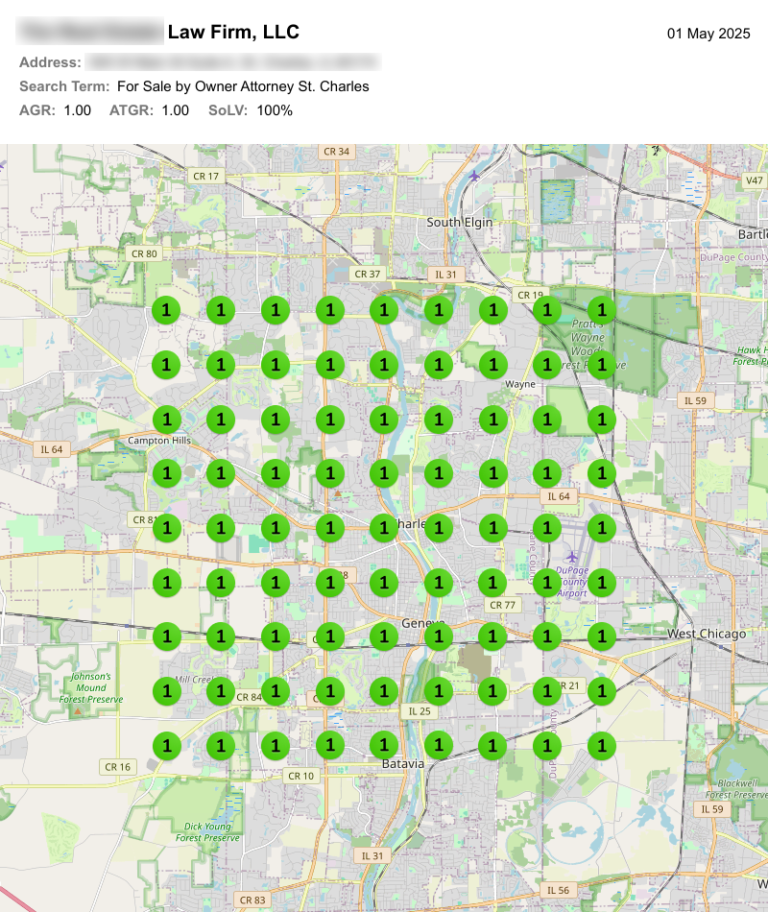
Short answer: choose a landscaping SEO company that measures Google Maps visibility across your whole service area, builds one page per service you actually sell (design-build, hardscape, irrigation, maintenance), reports calls and booked estimates rather than traffic, and will show you a client in your trade. Avoid anyone who guarantees rankings or hides what they do each month.
Landscaping SEO company checklist at a glance
| What to check | Good sign | Walk away if |
|---|---|---|
| Trade experience | Can name landscaping clients and the jobs they won (design-build vs. mowing) | “We do SEO for every industry” and no landscaping example |
| How they measure | Maps rank grid across your service area, re-run monthly | Rank checked only from their office or your address |
| What they report | Calls, forms, quote requests by service and source | Sessions, impressions, “domain authority” |
| Content plan | Service pages for high-ticket work first, seasonal pages planned | Generic blog posts, one “Services” page |
| Google Business Profile | Categories, services, photos, posts and review replies handled | GBP “optimized once” at onboarding |
| Contract | Month-to-month after 90 days, you own the site and content | 12-month lock-in, agency owns the domain or site |
| Pricing | Written scope; typical range below | Price with no scope, or “guaranteed #1” |
Why is landscaping SEO different from generic local SEO?
Landscaping is not one search. A homeowner looking for weekly mowing types a short, price-driven query and books in a day. A homeowner planning a paver patio or a full backyard design compares three or four companies over several weeks, reads reviews closely and looks at project photos. A property manager searching for commercial grounds maintenance wants a service area and a contract, not a gallery.
A company that treats all of that as “landscaping near me” will chase the cheapest work. The agencies worth hiring ask which services make your money, usually design-build, hardscape, irrigation and outdoor living, and build the campaign around those first. Maintenance and seasonal work come second, as route-filling pages for the towns where your crews already drive.
The second difference is seasonality. Demand for most landscaping searches peaks from March to June and again in early fall. An agency that starts your campaign in April and reports “traffic is up” in June has not proven anything. Ask them how they separate seasonal lift from their own work; the honest answer is a comparison against the same month last year and against your competitors’ movement.
What should a landscaping SEO company actually do each month?
Google Business Profile, every month, not once
For most landscaping companies the Business Profile produces more calls than the website. The agency should set the primary category correctly (Landscaper, Landscape Designer, Lawn Care Service and Hardscape Contractor are different categories with different results), list every service with a description, keep hours and service area current, add project photos regularly, post updates, and answer every review in your voice, including the awkward ones. If their proposal mentions the profile only as a one-time “optimization”, the most valuable asset in the campaign is being neglected.
One page per service, written for the buyer of that service
A paver patio page should answer what a paver patio buyer asks: materials, process from design to install, how long it takes, what affects the price, and photos of finished work. The same page should not try to sell mowing. Ask to see a service page the agency wrote for another landscaper. If it reads like a brochure with the city name swapped in, that is what you will get.
Location pages only where you want crews to go
If you serve a dozen towns, each one you want more work in deserves a real page, with the services you offer there and proof you have worked there. Fifty thin “landscaping in [town]” pages generated from a template is a tactic Google has been devaluing for years and it dilutes the pages that matter.
Reviews and photos as a system
Reviews are the strongest trust signal in the map results and the strongest conversion signal on the page. A good agency gives your crew leads a simple way to ask for a review at the final walkthrough and a way to collect before-and-after photos from every job. If the proposal does not include a review process, you will be asked for reviews later and have none.
Citations, links and technical fixes
Consistent business listings, a fast mobile site, clean page structure and a handful of earned links from suppliers, associations and local press round out the work. These matter, but they are the floor, not the campaign. An agency that leads its pitch with “backlinks” and “domain authority” is selling you the easy part.
How should a landscaping SEO company measure results?
Landscaping has a measurement trap that other trades do not: the season does half the work for the agency. Calls rise every spring whether anyone touches your SEO or not, so a report that says “leads up 40% since March” is weather, not marketing. Make them show year-over-year for the same months, and show your competitors’ Maps movement alongside yours.
Beyond that, insist on two measurements. A Maps visibility grid across your service area, scored per service and re-run monthly at the same points, because a design-build company that ranks on its own street and nowhere in the affluent suburbs it wants is not visible where the money is. And lead tracking that separates a $400 clean-up call from a $40,000 patio inquiry: calls and forms by service and by source, with the project type noted when it is known.
Then do the math by job type. If the campaign costs $3,000 a month and produced two design-build consultations and fifteen maintenance calls, the agency should be able to tell you that, and you should be able to decide whether that mix is the one you wanted. An agency that reports one blended “leads” number is hiding the mix.
What does landscaping SEO cost?
Most agencies do not publish prices, so treat these as reported ranges, not quotes, and get your own scope in writing. The figures below come from agency pricing pages and published comparisons checked on 6 November 2026.
- Entry packages: from about $249 a month for a template website, Business Profile basics and listings, aimed at owner-operators. Expect automated reporting and little custom content.
- Specialist local campaigns: roughly $1,500 to $4,000 a month for Business Profile management, service pages, reviews and reporting; several trade-focused agencies publish starting prices around $2,800.
- Multi-town or design-build programs: roughly $2,800 to $6,500 a month, usually with location pages, photo and video content and a larger content plan. Setup fees of up to a few thousand dollars are common in month one.
- Premium green-industry firms: some publish that clients spend $70,000 or more a year on strategy, content and video. That is a different purchase from local SEO.
- Website rebuild: often quoted separately, from a few thousand dollars for a service-page site upward.
Cheaper plans usually mean a template site, a one-time profile clean-up and automated reports. That can be enough for a maintenance-only company in a small market. It is not enough if you want design-build work in a competitive metro.
What questions should you ask before signing?
- Which landscaping companies do you work with now, and which of them do design-build or hardscape rather than maintenance?
- How will you tell seasonal demand apart from your own results in the reports?
- Can I see a Maps visibility grid for a landscaping client across their service area, not just at their address?
- Which of my services will you build pages for first, and how did you decide that?
- How will you get project photos from my crews into the Business Profile and the site every month?
- What is your plan for reviews, and how will you make it easy for a crew lead to ask at the final walkthrough?
- Will you track a patio inquiry differently from a mowing call, and will I see that split?
- Who owns the website, the domain, the content and the photos if we part ways?
- What is the contract term, and does it run through a full season before I have to decide?
- Which landscaping tactic have you dropped because it stopped working, and what replaced it?
The last two questions matter most. A contract that ends in February tells you nothing; you need to see at least one spring. And an agency that has never dropped a tactic has either not done landscaping before or will not tell you when something on your account produces nothing.
What are the red flags?
- They want to rank you for “landscaping near me” first. That query is dominated by mowing and clean-up buyers. If your money is in design-build, hardscape or irrigation, the plan should start there.
- Stock photos in the proposal. A landscaping campaign runs on your project photos. An agency that pitches with stock imagery has no plan to collect yours.
- No mention of the season. If the timeline and the reporting do not account for the spring surge and the winter trough, the results will be misread in both directions.
- Dozens of town pages at launch. Templated location pages are a volume play Google has been devaluing for years, and they bury the service pages that win projects.
- Guaranteed rankings or guaranteed leads. Nobody controls Google, and a lead guarantee usually means shared, low-value leads.
- They own the site or the photo library. The gallery you build over three years is a sales asset. Make sure it leaves with you.
- A twelve-month lock-in signed in autumn. You would pay through the dead months before seeing a spring. Ninety days, then month-to-month, keeps everyone honest.
When does it make sense to hire, and when should you wait?
Hire in late summer or fall if you can. Service pages take two to four months to rank, and the Business Profile work needs a few months of reviews and photos behind it, so a campaign that starts in September is ready when the spring searches begin. Starting in April means paying for the ramp during the months you least need help.
Wait if you have no project photos, under ten reviews, or no clear idea which services you want more of. Spend a month collecting photos from every finished job and asking every happy client for a review; those two things are free and no agency can make a bare profile rank. If you run paid ads, keep them through the first season and measure both channels; the right agency tells you which one is earning its cost rather than pushing you to drop one.
How BuiltRight Marketing approaches landscaping SEO
We are a contractor marketing agency, so this guide describes how we work as well as what to look for. Our landscaping marketing engagements start with a measured Maps grid across your service area, prioritize the services that make your money, and report calls and booked estimates by source. Our contractor SEO services page explains the monthly system, and our A.M. Woodland Outdoor Design case study shows the approach on a luxury landscape construction firm. If your site is the bottleneck, we also build contractor websites structured for this work from day one.
We are one option among many. Use the checklist above on us too.
Frequently asked questions
How long does landscaping SEO take to work?
Business Profile and review work can move Maps visibility within 30 to 90 days. New service pages usually need two to four months to rank for competitive design-build terms. Because demand is seasonal, judge the campaign across a full spring, not a single month.
What is the best time of year to start landscaping SEO?
Late summer or fall. The ramp happens during the slow months and the pages and profile are ready when searches surge in March and April. Starting in spring works, but you pay for the ramp when you need leads most.
Can an SEO company help me get design-build jobs instead of mowing?
Yes, if the campaign is built around design-build: dedicated service pages with real project photos, reviews that mention the type of project, and a Business Profile whose categories and services say landscape design and hardscape rather than lawn care.
Should a landscaping company have separate pages for each town?
Only for towns where you want more work and can show you have worked there. A few strong location pages with local projects and reviews beat dozens of templated ones, which Google has been devaluing for years.
How many reviews does a landscaping company need?
Enough to match or beat the companies above you in the map results for your core services, with recent ones that mention the kind of project. Steady monthly growth matters more than the total; a review asked for at the final walkthrough is the easiest to get.
Is SEO or paid ads better for a landscaping company?
Both, in different roles. Ads buy spring demand immediately and stop when you stop paying. SEO and the Business Profile build an asset that keeps producing design-build inquiries year after year. Most growing landscapers run ads to fill the next 60 days and SEO to own the next three seasons.
What should a monthly landscaping SEO report include?
Calls and forms split by service and source, with design-build inquiries separated from maintenance calls; Maps visibility across your service area measured at the same points as last month; a year-over-year comparison for the same month; what was done and what is planned next.
Want to see where your company is visible today? We map Maps visibility across your service area before anyone proposes anything. Request a visibility map and we will show you which towns are earning calls and which are dark.