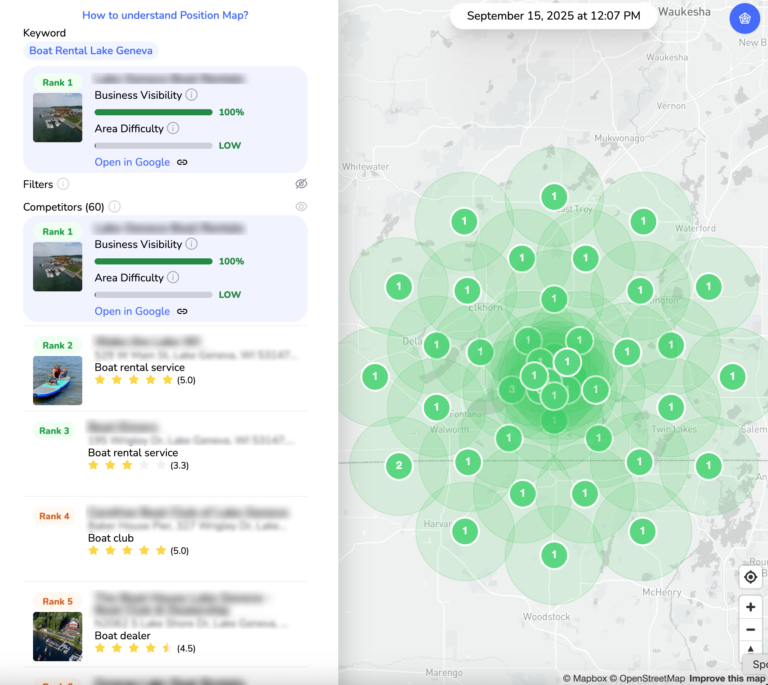
Short answer: choose a plumbing SEO company that can prove Google Maps visibility across your service area, builds a page for every service you sell (water heaters, drain cleaning, repiping, emergency repair), tracks calls to the Business Profile and the website separately, and reports booked jobs rather than traffic. Walk away from guaranteed rankings, agency-owned websites and twelve-month lock-ins.
Plumbing SEO company checklist at a glance
| What to check | Good sign | Walk away if |
|---|---|---|
| Trade experience | Names plumbing clients and the services they grew (water heaters, drains, repipes) | Generic “home services” deck with no plumber example |
| How they measure | Maps rank grid across your service area, re-run monthly | One rank number checked from their office |
| What they report | Calls by source (Business Profile, website, ads), split by service | Sessions, impressions, keyword counts |
| Google Business Profile | Categories, services, hours, photos, posts, review replies every month | Profile “set up” once at onboarding |
| Emergency intent | Mobile-first pages, click-to-call, after-hours stated near the top | Desktop-first site, phone number only in the footer |
| Contract | Month-to-month after 90 days, you own site, content and profile | 12-month term, agency-owned domain or site |
| Pricing | Written scope; typical range below | No scope, or “guaranteed #1 in Google” |
Why is plumbing SEO different from other local SEO?
Plumbing has two kinds of searcher and they behave nothing alike. The first has water on the floor. They search from a phone, read almost nothing, tap the first company in the map results that looks open and trustworthy, and call. The second is planning: a water heater replacement, a repipe, a remodel rough-in, a backflow test for a commercial property. They compare, read reviews, check whether you serve their town and often fill in a form at night.
Emergency work is won or lost in the Google Maps three-pack and in the first five seconds on your page. Planned work is won on service pages that answer real questions, including price ranges most plumbers avoid publishing, which is exactly why lead-generation aggregators own those results. A good plumbing SEO company builds for both: a profile and a mobile site that convert the emergency call, and service pages that earn the higher-ticket planned job.
The second difference is competition for the same searches. Plumbing is one of the most expensive trades in Google Ads, and the map results are crowded with franchises, aggregators and, increasingly, Google’s own Local Services Ads above everything. An agency that does not mention Local Services Ads, lead aggregators or the franchise in your market has not looked at your results page.
What should a plumbing SEO company do each month?
Run the Business Profile as the asset it is
For most plumbers the Business Profile produces more calls than the website. The agency should set the primary category (Plumber) and the secondary ones that fit (Water Heater Repair Service, Drainage Service, Gas Installation Service and so on), list every service with a description, keep hours accurate including emergency availability, add photos of real jobs and trucks, post updates, and answer every review in your voice. Unanswered reviews are the most visible neglect on a profile and a homeowner forms that impression in two seconds.
Build one page per service, written for the buyer of that service
Water heater replacement, tankless conversion, drain cleaning, sewer line repair, repiping, leak detection, gas lines, commercial plumbing: each gets a page that answers what that buyer asks, including what affects the price, how long the job takes, and what happens after they call. Ask to see a service page the agency wrote for another plumber. If it is a brochure with the town name swapped in, that is what you will get.
Location pages only where you dispatch trucks
Each town you want more work in deserves a real page with the services you offer there and proof you have worked there. Fifty templated “plumber in [town]” pages are a volume play Google has been devaluing for years, and they dilute the pages that matter.
A review system your techs can actually run
Reviews decide who gets the emergency call. The agency should give your technicians a one-tap way to ask for a review at the end of the job and a way to send photos from the field. A proposal with no review process means you will be asked for reviews later and have none.
Citations, speed and links as the floor, not the campaign
Consistent listings, a fast mobile site, clean structure and a handful of earned links from suppliers, associations and local press are necessary. They are not the strategy. An agency whose pitch leads with “backlinks” and “domain authority” is selling the easy part.
How should a plumbing SEO company measure results?
Plumbing is measured in calls, and calls are easy to count badly. A tracking number on the Business Profile and a different one on the website tells you where each call came from; without that split, nobody can tell whether the profile work or the site work is earning its fee. Insist on call tracking with recordings or at least outcomes, so a booked water heater replacement, a price-shopper and a wrong number are not reported as three leads.
Then insist on a Maps visibility grid: sample points across your dispatch area, each scored on where your profile appears for emergency repair, water heaters, drains and your other core services, re-measured monthly at the same points. A plumber who ranks at the shop and nowhere across the river is not visible where the trucks could be going.
Do the math per service. If the campaign costs $3,000 a month and produced six booked water heater replacements and forty drain calls, you should see both numbers, and you should know how many of those calls came after 5 pm, because after-hours conversion is where plumbing profiles win or lose. An agency reporting one blended “leads” figure is hiding the mix.
What does plumbing SEO cost?
Plumbing SEO is priced higher than most trades because the clicks, the franchises and the aggregators make every search more competitive. Few agencies publish prices, so read the figures below as reported ranges drawn from pricing pages and published comparisons checked on 6 November 2026, and get your own scope in writing before comparing anyone on cost.
- Entry packages: about $249 to $399 a month, often as a first-year rate with a setup fee, for a template website, Business Profile basics and listings. Expect automated reports and little custom content.
- Single-location plumber, local campaign: roughly $2,500 to $4,000 a month for Business Profile management, service pages, reviews, call tracking and reporting; trade-focused agencies publish starting prices around $2,800.
- Multi-truck or multi-city company: roughly $4,000 to $8,500 or more a month, with location pages, Maps work per location, video and photo content and a larger content plan.
- Business Profile management alone: published prices run from about $99 a month at the entry level to about $1,000 a month per location at full-service agencies.
- Website rebuild: often quoted separately, from about $1,000 for a template site to several thousand dollars for a custom build.
Plumbing costs more than most trades because the clicks and the competition do. The cheapest plans can hold a one-truck shop in a small town. They will not win water heater and repipe work in a competitive metro.
What questions should you ask before signing?
- Which plumbing companies do you work with now, and which services grew most: emergency repair, water heaters, drains or repipes?
- How do you track calls, and will I see them by source (Business Profile, website, ads), by service and by outcome?
- Who owns the tracking phone numbers if we part ways, and will my listings keep working?
- Can I see a Maps visibility grid for a plumbing client across their dispatch area, including after-hours searches?
- How will you handle Local Services Ads and the lead aggregators that sit above the map results in my market?
- Which services will you build pages for first, and will the water heater and repipe pages include price ranges?
- How will you make it easy for my technicians to ask for a review at the end of a job?
- Who owns the website, the domain and the content if we leave?
- What is the contract term, and what proof will I have at 90 days?
- Which plumbing tactic have you dropped because it stopped working, and what replaced it?
Question three is the one plumbers skip and regret. Agencies that put their own tracking numbers on your listings can take your call volume with them, and the citations keep pointing at a dead number for years. Question ten tells you whether you are talking to a specialist; every real plumbing campaign has pages and angles that produced nothing.
What are the red flags?
- Their tracking numbers on your listings. If the phone number in your Business Profile and citations belongs to the agency, your calls are theirs the day you leave.
- No plan for after-hours searches. Emergency plumbing is decided at 9 pm on a phone. If the proposal does not cover hours, emergency messaging and click-to-call placement, it misses the most valuable searches.
- Silence about Local Services Ads and aggregators. They sit above your map result in almost every plumbing market. An agency that has not looked at that results page has not looked at your market.
- Selling you leads instead of visibility. Shared pay-per-lead arrangements are a different business from SEO. Know which one you are buying.
- Guaranteed rankings. Nobody controls Google. A guarantee is a cheap keyword or a contract trick.
- Dozens of city pages at launch. Templated “plumber in [town]” pages are a volume play Google has been devaluing for years.
- They own your website. If the site lives on their platform and cannot be exported, the rankings you earned leave with them.
- Twelve-month lock-in before any call data. Ninety days is enough to see Maps movement and tracked calls start. After that, month-to-month keeps everyone honest.
When does it make sense to hire, and when should you wait?
Hire when you have technicians to answer more calls, a Business Profile you control, a phone that is answered after hours or a service that answers it for you, and a clear list of the services you want more of. Plumbing demand is less seasonal than most trades, so there is no bad month to start, but there is a bad state to start in.
Wait, and fix these first, if your profile has under ten reviews or no photos, if after-hours calls go to voicemail, or if you are not sure whether you want more emergency work or more planned work. No agency can rank a profile that looks closed, and a campaign that drives 9 pm calls into voicemail pays for leads you never hear. If you already run Google Ads or Local Services Ads, keep them through the first quarter and measure all three channels side by side; the right agency tells you where each dollar is earning its cost.
How BuiltRight Marketing approaches plumbing SEO
We are a contractor marketing agency, so this guide describes how we work as well as what to look for. Our contractor SEO services start with a measured Maps grid across your service area, prioritize the services that make your money, and report calls and booked jobs by source. Two plumbing case studies show the approach: Boss Plumbing’s Google Maps turnaround and a Business Profile rebuild for a home service plumber. We also run Google Local Services Ads for contractors alongside SEO when the results page calls for it, and build contractor websites structured for emergency and planned work from day one.
We are one option among many. Use the checklist above on us too.
Frequently asked questions
How long does plumbing SEO take to work?
Business Profile fixes and review growth can move Maps visibility within 30 to 90 days, and emergency calls follow quickly because that demand is constant. Service pages for water heaters, repipes and drains usually need two to four months to rank. Judge the campaign on a full quarter of tracked calls.
Should a plumber pay for leads or pay for SEO?
Pay-per-lead services sell the same lead to several plumbers and you own nothing afterward. SEO builds visibility you own. Many plumbers use aggregators while a campaign ramps and cut them as their own calls grow; just know which you are buying and track both.
Do I need Local Services Ads as well as SEO?
In most markets, yes. Local Services Ads sit above the map results for emergency searches and are paid per lead, not per click. SEO wins the map results and the planned work underneath. The two are measured separately and usually both earn their cost.
How important is after-hours availability for plumbing SEO?
Very. A large share of emergency searches happen evenings and weekends, and Google shows whether you are open. A profile marked closed at 9 pm, or a phone that goes to voicemail, loses the call to the next plumber regardless of rank.
Should my service pages show prices?
Ranges, yes. Water heater and repipe buyers search for prices, and the aggregators own those results because plumbers avoid publishing them. A page that explains what drives the price and gives a realistic range wins the planned work.
How many reviews does a plumbing company need?
Enough to match or beat the companies above you for your core services, with recent ones and replies to all of them. A homeowner with water on the floor picks the profile that looks open, rated and responsive; a review asked for at the end of the job is the easiest to get.
What should a monthly plumbing SEO report include?
Calls by source, service and outcome, including how many came after hours; Maps visibility across your dispatch area measured at the same points as last month; what the Local Services Ads and aggregators above you are doing; what was done this month and what is planned next.
Not sure where your trucks are visible after 5 pm? Before proposing anything, we measure where your profile appears for emergency and water heater searches across your dispatch area. Request a visibility map and we will show you which neighborhoods are sending calls and which never see your name.